
Classification: TLP:WHITE – Unrestricted Distribution
Report Generated: 2026‑04‑29 11:40 MST | Source(s): NVD (CVE‑2026‑0204, CVE‑2026‑0205, CVE‑2026‑0206) • SonicWall PSIRT SNWLID‑2026‑0004
Advisory Overview
| Advisory ID | SNWLID‑2026‑0004 |
| First Published | 2026‑04‑29 |
| Last Updated | 2026‑04‑29 |
| Status | Applicable (patches available) |
| Workaround Available | Yes |
| CVE(s) | CVE‑2026‑0204, CVE‑2026‑0205, CVE‑2026‑0206 |
| CWE(s) | CWE‑1390 (Weak Authentication), CWE‑35 (Path Traversal), CWE‑121 (Stack‑Based Buffer Overflow) |
| Overall CVSS v3 | 8.0 (vector AV:A/AC:L/PR:N/UI:R/S:U/C:H/I:H/A:H) – reflects the highest‑severity finding (CVE‑2026‑0204). |
| Direct Link | https://psirt.global.sonicwall.com/vuln-detail/SNWLID-2026-0004 |
Threat Alert
SNWLID‑2026‑0004 aggregates three newly disclosed vulnerabilities in SonicWall SonicOS firewalls. The flaws enable unauthenticated management‑interface access, path traversal to restricted services, and a stack‑based buffer overflow that can crash the appliance. Exploitation requires minimal skill; CVE‑2026‑0204 scores HIGH (8.0) while the other two score MEDIUM. Although no public exploits are known, the low attack complexity makes these issues attractive to opportunistic attackers and more sophisticated threat actors alike.
Executive Summary
Three distinct vulnerabilities affect all SonicWall Gen 6‑Gen 8 firewalls (hardware and virtual appliances) that have not yet been patched:
Patches have already been released for all affected platforms. Immediate remediation is required.
An attacker who gains admin control can modify firewall policies, exfiltrate credentials, or render the perimeter device unavailable.
Business impact: Full admin takeover (CVE‑0204) can alter firewall policies, open backdoors, or exfiltrate secrets. Path traversal (CVE‑0205) may expose configuration files and certificates. Buffer overflow (CVE‑0206) can cause service outages, affecting the availability of perimeter defenses.
Vulnerability Details
| CVE | Primary Impact | CVSS Base (CISA‑ADP) | CWE(s) |
| CVE‑2026‑0204 | Unauthenticated management‑interface functions become reachable then full device compromise. | 8.0 HIGH AV:A/AC:L/PR:N/UI:R/S:U/C:H/I:H/A:H | CWE‑306 (Missing Authentication), CWE‑1390 (Weak Authentication) |
| CVE‑2026‑0205 | Authenticated path traversal (../) to internal services then data leakage / further foothold. | 6.8 MEDIUM – AV:A/AC:L/PR:N/UI:R/S:U/C:L/I:L/A:H | CWE‑35 (Path Traversal) |
| CVE‑2026‑0206 | Stack‑based buffer overflow in a post‑auth routine then denial‑of‑service crash. | 4.9 MEDIUM – AV:N/AC:L/PR:H/UI:N/S:U/C:N/I:N/A:H | CWE‑121 (Stack‑Based Buffer Overflow) |
Technical Analysis
Root Causes
| CVE | Root Cause |
| 0204 | Missing or improperly enforced access‑control checks on management UI endpoints. |
| 0205 | Insufficient sanitisation of file‑path parameters, allowing ../ traversal to bypass directory restrictions. |
| 0206 | Bounds‑checking omission in a packet‑parsing routine, leading to stack corruption and process termination. |
Attack Surface & Exploitation Mechanisms
- CVE‑2026‑0204 – Unauthenticated Management Access
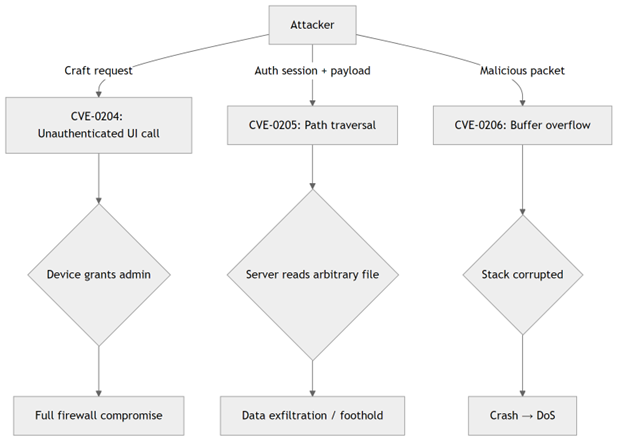
Attacker sends crafted HTTP/HTTPS request to a management endpoint (e.g., /admin/config) from any adjacent network segment. The firewall processes the request without authentication, granting full admin rights.
- CVE‑2026‑0205 – Path Traversal
Authenticated attacker invokes a file‑download or API call with a payload such as ../../etc/passwd (or URL‑encoded %2e%2e%2f). The server fails to canonicalise the path, exposing internal files or services.
- CVE‑2026‑0206 – Stack Buffer Overflow
Remote attacker sends a specially crafted packet to a post‑auth service (e.g., SSL‑VPN). The packet overflows a fixed‑size buffer on the stack, causing an immediate crash and denial of service.
Exploit Chain Diagram
Exploit Maturity
No public exploit code is currently available. However, the low attack complexity and high impact of CVE‑2026‑0204 make it a prime candidate for rapid weaponization. The advisory’s “Applicable” status indicates that patches are already released, underscoring the urgency to apply them before any exploit emerges.
Affected Systems & Versions
| Generation | Platform (Hardware / Virtual) |
| Gen 6 | SOHO‑W, TZ 300/300W/400/400W/500/500W/600, NSA 2650/3600/3650/4600/4650/5600/5650/6600/6650, SM 9200/9250/9400/9450/9600/9650, TZ 300P/TZ 600P, SOHO 250/250W, TZ 350/350W |
| Gen 7 – NSv | NSv 270, NSv 470, NSv 870 (ESX/KVM/HYPER‑V/AWS/Azure) |
| Gen 7 – Firewalls | TZ 270/270W, TZ 370/370W, TZ 470/470W, TZ 570/570W, TZ 570P, TZ 670, NSa 2700/3700/4700/5700/6700, NSsp 10700/11700/13700/15700 |
| Gen 8 | TZ 80/280/380/480/580/680, NSa 2800/3800/4800/5800 |
Note: The Fixed Software list in the advisory mirrors the above platforms – patches have been released for every model shown.
Workaround / Mitigation
Until firmware updates can be applied, SonicWall PSIRT recommends the following hardening steps:
- Disable HTTP/HTTPS‑based firewall management on all interfaces.
- Disable SSL‑VPN services on all interfaces.
- Restrict management access to SSH only, and limit SSH source IPs to trusted networks (e.g., VPN subnet).
These actions eliminate the attack vectors used by CVE‑2026‑0204 and CVE‑2026‑0205, while also reducing exposure for the buffer‑overflow bug.
Patch Information
- Fixed Firmware – The vendor has released patches for every platform listed in Affected Platforms. Administrators should upgrade to the latest SonicOS release (e.g., version 6.5.5.2‑28n or later for Gen 6; corresponding versions for Gen 7/8).
- Verification – After upgrading, confirm the firmware version via the CLI (show version) and ensure that the patch level matches the “Fixed Platforms” list in the advisory.
Additional Comments (Gen 6 Downgrade Warning)
- Downgrading a Gen 6 appliance from 6.5.5.2‑28n to any earlier firmware is not supported.
- The downgrade can delete all LDAP users and reset MFA settings.
- If a rollback is ever required, administrators must manually re‑create LDAP accounts and re‑configure MFA after the downgrade.
- A full configuration backup before upgrading is strongly recommended.
Threat Context & Real‑World Risk
| Actor Type | Motivation | Likelihood |
| Commodity attackers / script kiddies | Ransomware, botnet recruitment | High – low barrier to exploit. |
| Organised crime | Steal credentials, sell access to critical infrastructure | Medium – will combine with credential‑theft tools. |
| APT groups | Long‑term espionage on high‑value networks | Low‑Medium – requires development of a custom exploit for CVE‑0204. |
Priority Rating
| Overall Severity | Recommended Action |
| HIGH (driven by CVE‑2026‑0204) | Patch within 72 hours; treat as emergency. |
| MEDIUM (CVE‑2026‑0205, ‑0206) | Patch within 7 days; apply workaround immediately if patching is delayed. |
Indicators of Compromise (IoCs)
Network Indicators
| Type | Indicator | Context |
| URL pattern | /admin/* accessed from non‑trusted IPs | Possible CVE‑0204 exploitation. |
| Path traversal payload | ../..//, %2e%2e%2f in query strings (e.g., /download?file=../../etc/passwd) | CVE‑0205 attempts. |
| Malformed packets | High‑frequency small TCP segments to management ports causing abrupt resets | CVE‑0206 DoS attempts. |
Host Indicators
| Indicator | Description |
| Process crash / restart of sonicOS service | Buffer overflow trigger (CVE‑0206). |
| New admin sessions without prior authentication logs | Bypass of access control (CVE‑0204). |
| Unexpected file reads from /etc/ or other privileged locations via the firewall UI/API | Path traversal activity. |
Detection Signature (Sigma/yaml)
title: SonicWall SNWLID-2026-0004 Exploitation Attempt
id: 8f2c1d3e-7a9b-41c5-b0ef-9c6d5fa2b8a1
status: experimental
description: Detects suspicious management‑UI calls, path‑traversal payloads, or crash‑inducing packets targeting SonicWall firewalls (SNWLID‑2026‑0004).
author: Automated Threat Intel Engine
date: 2026-04-30
logsource:
product: sonicwall
service: firewall
detection:
auth_bypass:
EventID: 1001 # example ID for admin UI access
Message|contains: ‘/admin/’
SrcIP|not_in:
– 10.0.0.0/8
– 192.168.0.0/16
path_traversal:
EventID: 1012
Message|contains: ‘../’
buffer_overflow:
EventID: 1025
Message|contains: ‘stack overflow’ # typical crash log entry
condition: 1 of auth_bypass, path_traversal, buffer_overflow
falsepositives:
– Legitimate remote management from approved IP ranges.
level: high
References & Further Reading
| Resource | Description |
| NVD – CVE‑2026‑0204 | https://nvd.nist.gov/vuln/detail/CVE-2026-0204 |
| NVD – CVE‑2026‑0205 | https://nvd.nist.gov/vuln/detail/CVE-2026-0205 |
| NVD – CVE‑2026‑0206 | https://nvd.nist.gov/vuln/detail/CVE-2026-0206 |
| SonicWall PSIRT Advisory (SNWLID‑2026‑0004) | https://psirt.global.sonicwall.com/vuln-detail/SNWLID-2026-0004 |
| Official SonicWall Firmware Update Notice | https://www.sonicwall.com/support/notices/security-advisory-firmware-update-required-gen-6-gen-7-and-gen-8-firewalls/ |
| CWE‑1390 – Weak Authentication | https://cwe.mitre.org/data/definitions/1390.html |
| CWE‑35 – Path Traversal | https://cwe.mitre.org/data/definitions/35.html |
| CWE‑121 – Stack‑Based Buffer Overflow | https://cwe.mitre.org/data/definitions/121.html |
Report generated by Dataprise, Dallas Myers | 04/29/2026 11:40 MST | Classification: TLP:WHITE